


A funeral poem can sometimes say in four lines what a speaker cannot put into five minutes. In a funeral presentation that works best when the text is short, large on the screen and given time. In this article you will read where to find a suitable poem or quote, how copyright works, and how to write a few lines yourself if nothing you find feels right.
Where can you find the right poem for a funeral?
Most people start with a search engine and find hundreds of farewell poems. That works, but it takes a lot of time and the quality varies widely. Often the source is closer than you think.
First, look at what the person who died liked to read themselves. A collection on the bookshelf with a turned-down corner, a poem stuck to the fridge, a text copied into a diary. Families quite often come across something like this while sorting through belongings, and then the choice has really already been made.
Other good places to look:
- The funeral director. Many funeral directors keep a folder or list of texts that are often used, and are happy to help you think it through.
- The library. Libraries have anthologies of poems about farewell and grief, and the librarians will gladly help you search.
- Wikisource. Here you will find many older English texts, including work by poets whose writing is now free to use.
- A faith community. A minister, priest or celebrant knows suitable psalms, prayers and hymns, and which translation is customary.
As a starting point, many families choose poems such as "Death is nothing at all" by Henry Scott Holland, "Remember" by Christina Rossetti, "Crossing the Bar" by Alfred, Lord Tennyson, "Funeral Blues" by W. H. Auden or "Do not stand at my grave and weep" by Mary Elizabeth Frye. Please note: Holland (who died in 1918), Rossetti (1894) and Tennyson (1892) are free to use. The work of Auden (who died in 1973) and Frye (2004) is still protected, see below.
Poems, quotes and copyright
A poem is a work, just like a book or a song. In the UK, copyright in a literary work expires 70 years from the end of the calendar year in which the author died (section 12 of the Copyright, Designs and Patents Act 1988). After that the work is free and anyone may use it.
What does that mean for a slide during a funeral service? We are not lawyers, and there is little clarity about funerals specifically. If the service is streamed or recorded, or open to everyone, the text reaches more people than just those in the room. A few practical rules of thumb:
- Always credit the poet. Under the poem, in smaller lettering: their name and, if you know it, the title of the collection.
- Unsure about a complete poem by a living or recently deceased poet? Then ask the publisher for permission. This usually goes by email and is often quickly arranged. Mention that it is for a single showing at a funeral.
- Is the service being streamed or recorded? Then the text reaches more people than just the chapel. Take extra care with permission in that case.
- A single line as a quote with the poet's name is less of an issue than a whole poem, but always give the source then too.
The same goes for song lyrics: do not put complete lyrics on a slide. Let the song be heard instead. You can read more about playing music in music rights at a funeral.
Texts that are free to use
Old poems by poets who died long ago are free, as the examples above show. Bible texts are a special case in the UK. Many families choose the familiar wording of the King James Version, for example the opening of Psalm 23:
The LORD is my shepherd; I shall not want.
Please note: in the UK, rights in the King James Version (the Authorised Version) are held by the Crown, so it is not simply out of copyright here as it is in many other countries. Modern Bible translations are protected too. A minister or celebrant usually knows which text and translation you can use.
Writing a few lines yourself
Not everyone finds an existing poem that fits. In that case you can write something yourself. It does not have to be a proper poem with rhyme. A few short sentences about something everyone in the room will recognise often work better than grand words.
A few pointers:
- Start with something small and concrete. A habit, a place, an object. Not "he was always so caring", but what he actually did.
- Keep it short. Two to six lines is enough.
- Let go of rhyme if it starts to feel forced. Forced rhyme soon sounds like a greetings card.
- Read it aloud. What flows well when spoken also reads well on a screen.
For inspiration, here are a few examples we wrote ourselves for this article. You are free to use or adapt them:
Your chair still stands by the window.
The light doesn't know you're gone.
Your hands always knew what needed doing.
For now, we don't.
What you said remains.
What you did, longer still.
Coffee every morning at seven.
Tomorrow we will make one for you.
No grand story.
Just this: you were there. Always.
You can also use lines like these as a short text for a chapter of photos. You can read more about opening and closing texts in words in a funeral presentation.
A poem on a slide: short, readable and unhurried
A poem that sounds beautiful when read aloud is not always easy to read on a screen. People in the chapel are sometimes ten metres or more from the screen, and not everyone sees equally well.
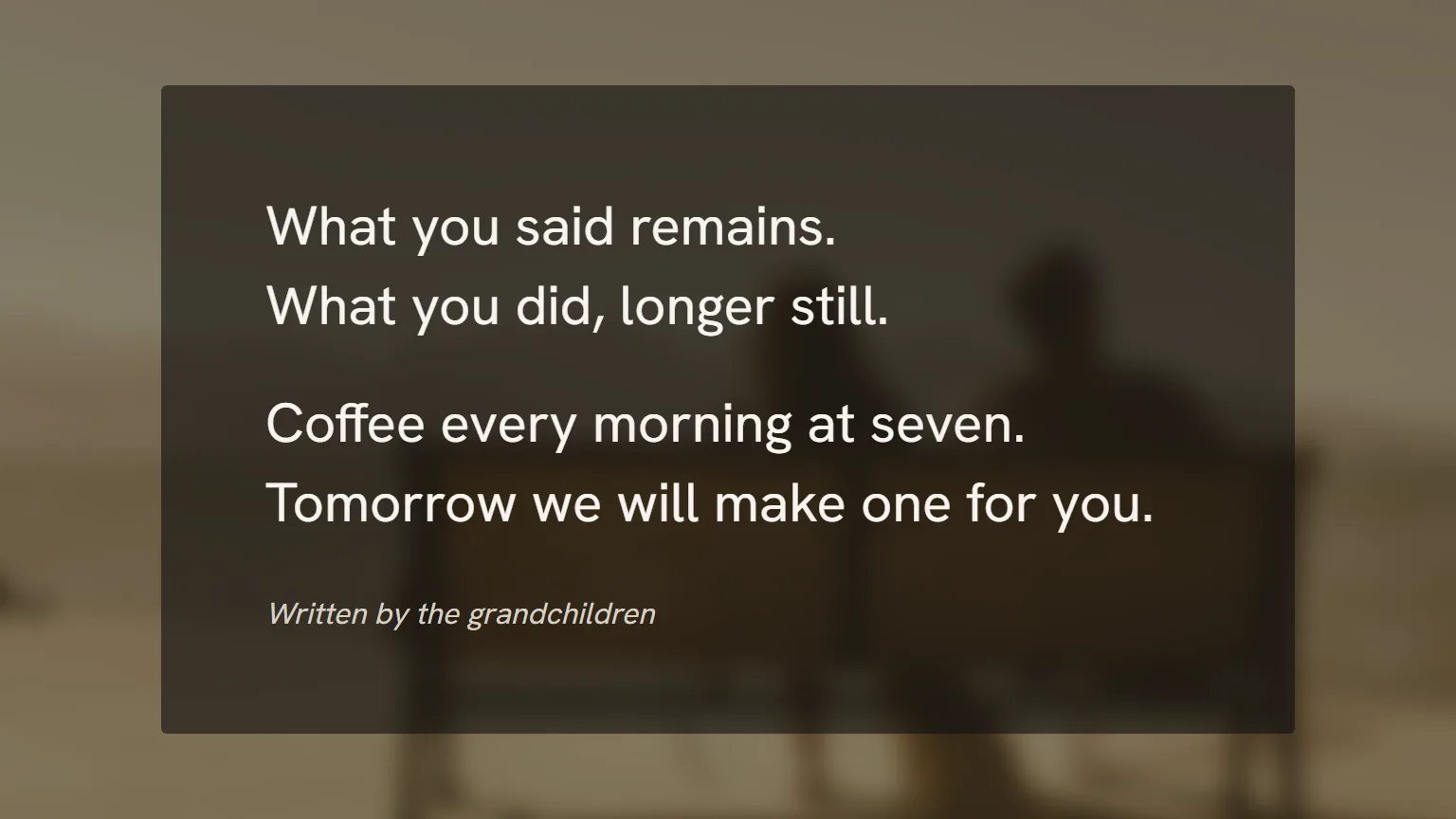
Practical guidelines:
- No more than 8 lines per slide. If the poem is longer, spread it over two slides or choose one verse.
- Large lettering, plenty of space. Better too big than too small. Leave generous margins all round.
- A calm background. A photo with lots of detail makes text hard to read. Choose a plain or dark background, or a photo that is heavily blurred. More on this in the article on design and background for a funeral slideshow.
- A small credit at the bottom. The poet's name, perhaps the collection. For your own text, for example, who wrote it.
- Give it time. Allow roughly twice the time you need yourself to read it calmly.
Where does a poem fit in the service?
A poem often appears at one of these moments:
- At the entrance, as the first image after the memorial photo.
- While someone reads it aloud. The text is then on screen too, so people can read along.
- As a quiet moment between two speakers.
- At the final farewell, as the closing image.
In our tool, the easiest place for a poem is a speaker block. The tool does not put text on a slide itself, so you first make the poem into an image and choose it as the photo for the speaker, instead of the fixed memorial photo. A block like this stays on screen until the operator clicks on, so nobody is interrupted halfway through a line. Would you rather show the poem during a music moment? Then keep it very short, because the slides in a music with photos block move on by themselves. You can see how the different blocks work under the blocks of a funeral presentation. Want to see the whole process from start to finish? Then read how to make a funeral presentation, step by step.
Sources
Frequently asked questions
Can I put a poem by a well-known poet in the funeral presentation?
Whatever you do, always include the poet's name. If the poet died less than 70 years ago, the work is still protected. For a complete poem it is wise to ask the publisher for permission, especially if the service is being streamed or recorded.
How long should a poem stay on screen?
Long enough to read it calmly twice. That is why a poem works best at a point where the operator clicks on manually, rather than in a block that moves on by itself.
I'm not a writer. Does my own text have to rhyme?
No. A few honest sentences about a habit or a place often work better than rhyme. Read it aloud to someone else; if it sounds natural, it is good.
Can a poem run over several slides?
Yes. For a longer poem you can give each verse its own slide. Make sure the transition is gentle and that the credit appears on the last slide.