

Almost every funeral has music, and most families never stop to think that the music is protected by copyright. In the UK, PRS for Music and PPL look after those rights, and for the service itself the good news is that they do not require a performance licence. Things change if you stream the service online or share the presentation with music afterwards. In this article you can read how funeral music copyright works, as far as we have been able to check.
This article is a general explanation and not legal advice. Arrangements can differ from venue to venue and change over time. If in doubt, ask the venue or your funeral director.
Why is music protected by copyright?
A song has several rights holders. The composer and the lyricist own the copyright in the song, as does their publisher. The singer, the musicians and the record company who made the recording have rights in the recording itself.
In the UK, two organisations collect money when music is played in public. PRS for Music does this for songwriters, composers and publishers, and PPL for performers and record companies. Together they sell TheMusicLicence through PPL PRS. According to PPL, if you want to play recorded music in public, for example to staff or customers at your business premises, "you'll need a licence from PPL PRS". The Copyright, Designs and Patents Act 1988 makes "the playing or showing of the work in public" an act restricted by copyright.
Music you play at home is not covered by this. A funeral sits somewhere in between: it is a private gathering, but it can still mean a chapel full of people.
Music during the service: what does the venue arrange?
PPL's Churches Tariff for 2026 contains a clear note: weddings, funerals and christenings "are deemed as domestic rather than public events and hence are not licensable". CCLI, which handles church copyright licences in the UK, puts it like this: "Phonographic Performance Ltd (PPL) and PRS for Music have both waived the requirement for music performance licences during weddings and funerals." That waiver applies "as long as the service is not being recorded or streamed over the internet".
In practice, music at a crematorium usually runs through the venue's own music system. Many crematoria use a supplier such as Obitus or Wesley Media. Obitus says it is "bound by legal licensing obligations" and must buy a track before it can be added to its library. York Crematorium, which works with Obitus, asks families to choose commercially available tracks "released by the artist only (owning to licensing laws)". At the City of London Cemetery and Crematorium all music is arranged through your funeral director in advance, from a database that can be added to if a piece is missing.
What does this mean for you? As far as we know, you do not need to apply for any licence yourself to have music played at the service. Costs for the music system are part of what the venue or funeral director charges, and at some venues a longer service with more music costs extra. To be sure, just ask. You can do that in the same conversation in which you discuss how to deliver the funeral presentation to the venue.
Check the venue's rules
Some venues are strict about how music arrives. The City of London Cemetery and Crematorium "strongly discourage[s] bringing CDs or DVDs on the day" and asks that all music is arranged with your funeral director beforehand. In a church, the order of service is another point: according to CCLI, the church is responsible for copyright permission for printed hymn words, even when the family has designed and printed the sheets.
It is a good reason simply to buy the music you hand over, or to use your own collection, rather than downloading it from a doubtful website.
Spotify, YouTube and the file itself
In a funeral presentation, the music is a file inside the presentation. So you cannot just "put Spotify on" in the chapel, and you are not simply allowed to. Spotify's terms give you permission "to make personal, non-commercial use of the Spotify Service and the Content". Crematorium systems work the same way: Obitus says that if a track comes from a streaming or video service such as Spotify or YouTube, it will look for a legal, licensed version, and that a version which only appears online may not be usable.
So use a music file you have bought, for example from a download store, or a track from your own CD. Many venues also have their own music library you can choose from. You can read more about the file and the length of songs in choosing music for a funeral.
Livestream and recording of the service
More and more funerals are streamed for people who cannot be there. Music in a livestream is treated differently from music in the room, because it then goes out over the internet.
What we found in practice:
- The waiver from PPL and PRS for Music does not cover recording or streaming. According to CCLI, if a service is recorded, the music captured on it needs permission, and the Limited Manufacture Licence from PRS for Music is the best way to obtain it. PPL's Churches Tariff says the same about recordings.
- Crematorium webcasts are usually arranged through the venue's supplier. At the City of London Cemetery and Crematorium the livestream is provided by Wesley Media, arranged directly with them or through a funeral director, at an extra charge. Obitus sends unique login details for each service, and the recording can be watched for a further 28 days.
- CCLI writes that if the family wish to make the service available online themselves, "they must take responsibility for obtaining the appropriate permissions", and recommends contacting PRS for Music directly.
If the stream goes through the venue or a specialist provider, they often have arrangements for this: Obitus, for example, says licensed providers handle the separate permissions for livestreams. Ask how they handle the music. If you set up a stream yourself on YouTube or Facebook, there is a real chance the music will be recognised and the broadcast cut off. You can read more in the article on showing the funeral presentation on a livestream.
Sharing the presentation with music online
After the funeral, families often want to share the presentation with people who could not be there. This is where the risk of trouble is greatest.
If you upload a video of the presentation to YouTube, it is checked against a large database of music (Content ID). According to YouTube itself, a rights holder with an agreement can choose to "monetise", "block" or "track" the video: run adverts on it, block it or simply follow it. YouTube checks every video during the upload, before you choose whether it is public, unlisted or private. Setting a video to unlisted or private therefore does not protect you from a claim. The result can be that the sound is muted or that the video cannot be watched.
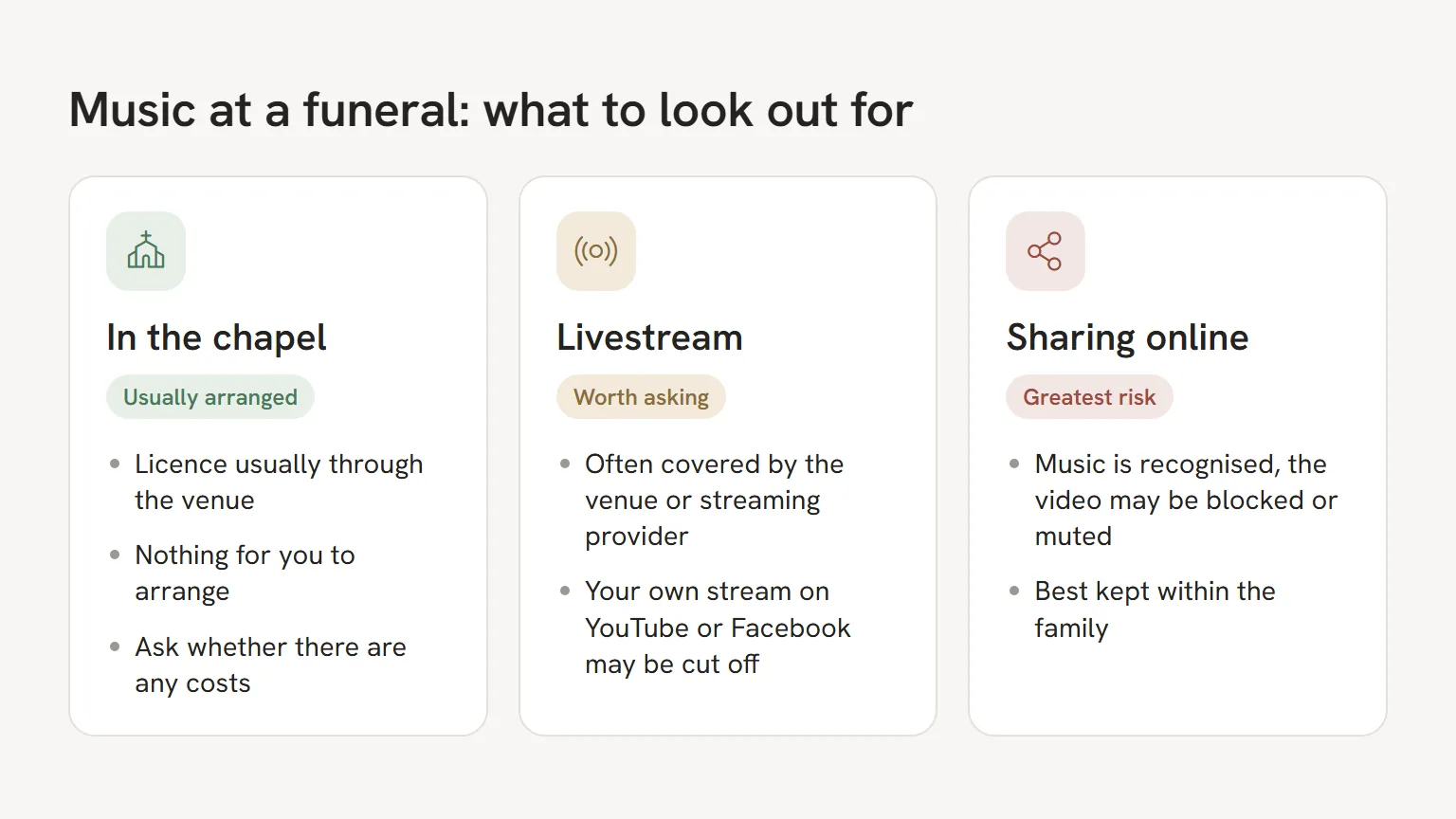
It is more practical to keep the presentation within the family. For example by sharing the file between you, or by watching it together. The presentation you make with us is a PowerPoint file with a download link; only share that link with people you know. Bear in mind that we delete data 30 days after the funeral, so download the file in good time if you want to keep it. You can find ideas for later in keeping the presentation and using it at a memorial.
If you would also like to show the presentation at the wake or a reception, the same applies as for the service: ask whether music is covered at that venue.
The full process, from running order to delivery, is in our guide to making a funeral presentation.
Sources
Consulted on 16 October 2026.
- PPL, Churches Tariff 2026 (PPLPP115), including the note on weddings, funerals and christenings
- PPL, Music licensing: which licence is right for me?
- Copyright, Designs and Patents Act 1988, section 19 (legislation.gov.uk)
- CCLI, Weddings and Funerals (UK)
- Obitus, Funeral Music (FAQ on licensing and tracks)
- Obitus, How to choose the perfect funeral music (FAQ on Spotify, livestreams and tribute videos)
- Obitus, Streaming
- City of York Council, York Crematorium: funeral music and media
- City of London, Cremation options (City of London Cemetery and Crematorium)
- Spotify, Terms of Use (UK)
- YouTube Help, Content ID for music partners
- YouTube Help, How Content ID works
Frequently asked questions
Do I have to pay PRS or PPL for music at a funeral?
Not for the service itself. PPL and PRS for Music have waived the need for a performance licence for music played during a funeral service, as long as the service is not recorded or streamed online. Crematoria play music through their own music system, and any costs are part of the venue's or funeral director's fees. Ask the venue if you are unsure.
Can I use music from Spotify in the funeral presentation?
A Spotify subscription is for personal, non-commercial use, and you cannot put the songs into a presentation as separate files. Use a music file you have bought or a track from your own CD, or choose from the venue's music library.
Why does a funeral livestream sometimes get cut off?
Platforms such as YouTube recognise protected music automatically. The rights holder can then have it blocked. Ideally use the venue's stream or a specialist provider, and ask how they handle music.
Can I put the presentation with music on Facebook or YouTube?
There is a real chance the music will be recognised and the video blocked or muted. It is better to keep the presentation within the family, for example by sharing the file between you.