

· Last updated on
Music adds an enormous amount to a funeral service. Even so, choosing it needn't be a struggle: with a few practical starting points you can arrive at something that both suits the person who has died and works well within the service.
How many pieces do you need?
Most services have room for three to five musical moments:
- Arrival: gentle music while guests take their seats and the coffin or urn is carried in.
- Between the speakers: a piece as a moment to breathe, often accompanied by a series of photos.
- The final farewell: the moment when those present file past the coffin or form a guard of honour. Choose a piece that can be repeated here, as you cannot know in advance how long this moment will last.
- The reception: music before or after the service (often arranged by the venue itself, though you can usually still have a say).
Together with the funeral director you will settle the overall size of the funeral. The venue, and with it the size of the room, is estimated from the expected number of people. After that, agreements are made about how long the service will run. On average this is somewhere between an hour (a small service) and one and a half to two hours (a larger one). This is separate from the reception before or after the ceremony.
The more time there is, the more room there is for music and speakers. An average funeral lasts about an hour, and within that there is room for three to five speakers, with three or four pieces of music in between. Add one piece for the arrival and one for the exit, and you reach a maximum of around six pieces. Ask the speakers too how long they expect to speak, so you have a clear picture.
Choose from the person, or from the speaker
The most moving choice is music that genuinely belonged to the person: the song from their wedding day, the record that was always on in the car, the tune that was sung along to in the kitchen. An 'inappropriately' cheerful song that makes everyone think of them often lands more deeply than a solemn classical piece nobody recognises.
Here is another lovely approach. If the person who has died left no wishes of their own, you choose the arrival and the exit together as a family, while the piece after a speaker is chosen by that speaker. That can turn it, especially when the photos are matched to it, into a hugely meaningful moment within the service, offered by someone to whom the person meant a great deal.
Live music
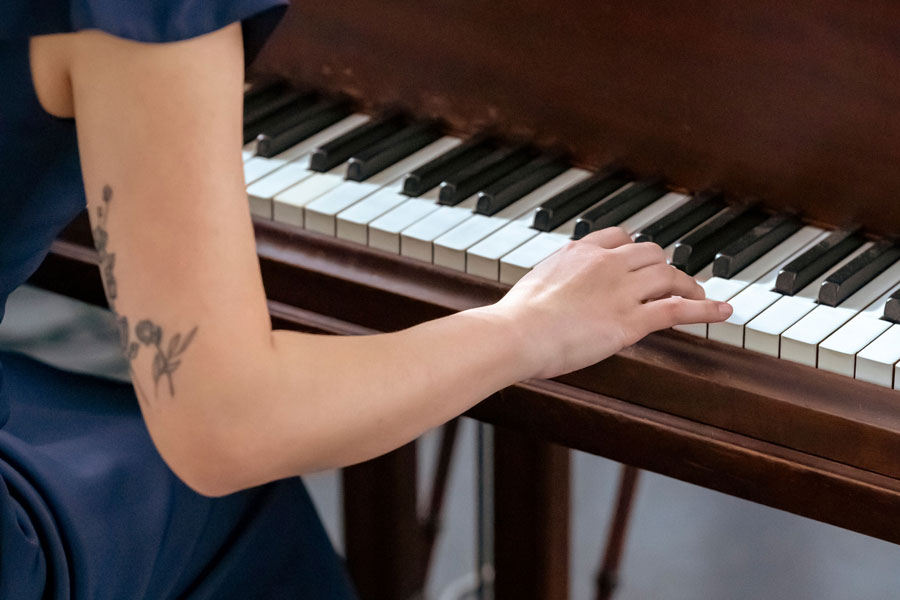
Arranging live music for the funeral is also an option. It happens less often, but most funeral venues are prepared for it (and have regular partners) when a pianist, harpist or guitarist is wanted. It is often at its best to show no photo slideshow during this music. If a slideshow is wanted after all, it is wise to ask the musician how long they take over a particular piece.
Mind the length
A series of photos set to music works best when there is room to let a particular image linger in the mind for a moment. Depending on the tempo of the piece, we recommend keeping each photo on screen for at least six seconds.
For a calmer pace, though, we recommend allowing at least eight seconds per photo. Don't forget that when you work out how many photos fit within a given piece, you have to allow for the length of the transition from one photo to the next. That animation time is added on top.
For a service of an hour, then, you can comfortably choose three or four pieces of three to four minutes. But if there is a long piece of six or seven minutes among them, it effectively counts as two, or the speakers are left with less time.
It helps to give each song a chapter of its own. The first song might be about childhood, the second about family life, the third about the later years. You can work out how many photos you need per song in how many photos a funeral presentation needs.
The practical side: the file itself
- Use a good-quality file (mp3, wav or m4a from a reliable source, not a recording of YouTube made on your phone). There are various ways to obtain music online.
- Check the start and the end: some pieces have a long silence or an abrupt opening. Set a fade in PowerPoint, or edit the piece in an audio program.
- Test the volume. Make sure the pieces sound reasonably even, especially at their loudest moments, and ask the venue to check this too if you are unsure.
In the running order
For each musical moment, note in the running order which piece plays and whether it continues automatically or waits for a click. In a funeral presentation built with our tool, the music starts automatically at the right moment and carries on across the photos. The operator has nothing to do until the next cue. For them this is the ideal way to receive a presentation, because nothing can go wrong and a click is only needed at exactly the right moment.
Music is one part of the presentation. How to bring everything together is explained in making a funeral presentation: a step by step guide.
Frequently asked questions
Do you have an overview of the most commonly chosen funeral music?
Yes. We keep a separate article on the most played funeral songs, based on the songs families choose year after year. The most common choices include My Way (Frank Sinatra), Time to Say Goodbye (Sarah Brightman and Andrea Bocelli), Somewhere Over the Rainbow (Israel Kamakawiwo'ole) and Angels (Robbie Williams). For the arrival and the final farewell, instrumental pieces by Ludovico Einaudi are often used, in particular Una Mattina and Nuvole Bianche.
Beyond that, tastes really do vary widely these days. Over the years so much music has been released that it depends enormously on the life and the personality of the person who has died.