
Recently I sat at a family's kitchen table. Three shoeboxes full of photos, a half-eaten plate of cake, and a discussion I have seen many times: can we include that one photo of Dad jumping off the diving board in swimming trunks that are far too tight? The daughter thought not. The son thought so, "because that's who he was". The photo went in. During the service, people laughed out loud at it, right in the middle of their grief.
I make funeral presentations, for families and for funeral directors. And however natural such a presentation feels by now, the custom is surprisingly young. The need behind it is not. For centuries, people have looked for ways to keep the person who has died visible during the farewell. This is that history: from village rituals and the very first mourning photographs to the screens in today's crematorium chapels.
When every village had its own way of saying goodbye
Funeral customs used to vary enormously. What belonged in one village was unheard of in the next. In the countryside, neighbours had duties: they announced the death, sat with the deceased through the night and carried the coffin to the churchyard. In parts of Wales and the north of England, a "bidder" went from door to door, dressed in black, to announce the death and to invite, or "bid", people to the funeral. That role is a direct forerunner of the funeral director.
After the burial, many regions held a funeral feast. In the north of England it was known as the arvel, with special arvel bread and plenty of ale; elsewhere there were funeral biscuits and wine. These gatherings could get out of hand, and the churches and local authorities regularly tried to rein them in. In the second half of the nineteenth century the hot meal gave way to a simpler affair: tea and sandwiches. We still know that funeral tea today.
Remembering without a picture
All those rituals revolved around remembrance. But for a very long time, remembrance had to manage almost entirely without a picture. A painted portrait was reserved for the elite. For ordinary people, quite literally no face remained after a death, only the memory in the minds of those left behind.
The photograph arrives
In 1839 the Frenchman Louis Daguerre presented the daguerreotype, one of the first photographic techniques. For the first time, an image of a loved one came within reach of a large group of people. That led to a custom that seems strange to us now, but was perfectly normal at the time: post-mortem photography, photographing someone who had just died.
The reason was both practical and moving. Child mortality was high in the nineteenth century, and many people had never been photographed. A post-mortem photograph was often the only portrait ever made of someone. The deceased was pictured as lifelike as possible, sometimes seated in a chair, sometimes even with the coffin stood upright for better lighting. Prints were sent to relatives who lived too far away to attend the funeral, a kind of mourning card with a picture.
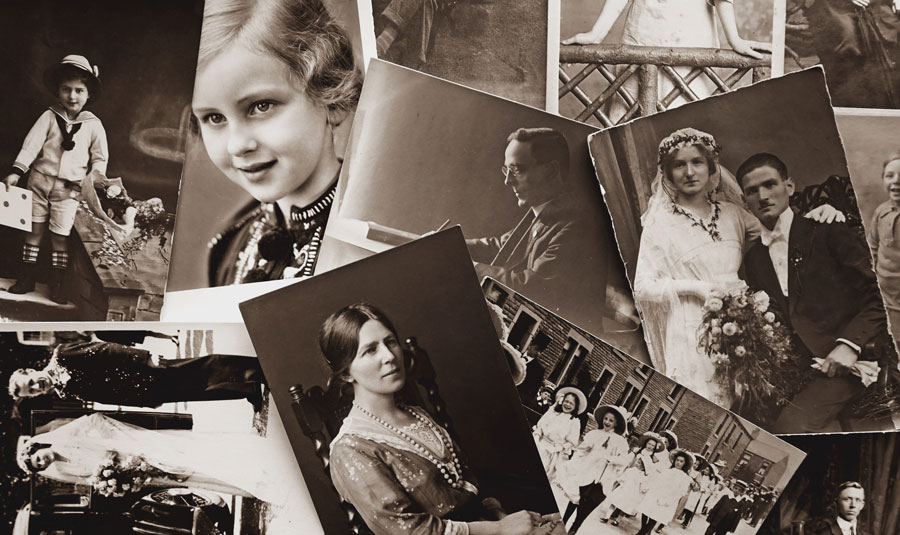
In the early twentieth century, cameras became affordable and almost everyone had portraits taken during their lifetime. The post-mortem photograph disappeared and the mourning photo taken in life took its place. A framed portrait on or beside the coffin, a small picture on the memorial card, which by then had a black border and a verse. Families were careful with that one good photograph. I once held a memorial card from the 1930s on which the portrait had visibly been cut out of a group photo: someone else's shoulder was still half in the frame. That was all there was.
Screens in the chapel
With the rise of crematoria and funeral homes in the second half of the twentieth century, the place of farewell changed. Alongside the church, the crematorium chapel became the central space for the service. Chapels were gradually better equipped: first with sound systems for music and the spoken word, later with projectors and screens.
At first, that screen was used for what already existed: the mourning photo. Instead of just a framed portrait by the coffin, the face of the deceased now appeared large on screen, visible right to the back row.
The first funeral presentations: clicking by hand
If one photo works, why not more? Families began bringing in series of photos, the life of the deceased in pictures. Technically, there was little to it: a folder of loose images on a computer, with a member of staff at the crematorium or a family member clicking from one photo to the next during the service.
A funeral director I work with a great deal tells wonderful stories about this. In her early days she worked with agreed signals: a nod from the speaker meant "next photo". If it went wrong, Grandad hung upside down for three minutes above a story about the allotment. It was makeshift, but the power of the idea was immediately clear. A series of photos tells a life story in a way that words alone cannot.
PDF and PowerPoint take over
Then the loose pictures were bundled together. The PDF gained ground as a delivery format, because a PDF looks the same on every device and can be paged through one page at a time. More and more venues made it possible to connect a PowerPoint to their screens, or even asked families explicitly to deliver their photos as a presentation.
That put the family in charge. You decided the order yourself, could add a name or a year, and could have the slides advance automatically to music. To this day, many crematoria publish instructions on their website on how best to deliver such a presentation. At the same time, a barrier remained. Not everyone is at home in PowerPoint, and certainly not in the days between a death and a funeral. I see it regularly: a son-in-law still shuffling slides at midnight because he is "the only one who understands that programme", when all he really wants is to sit at the table with the family.
The funeral presentation today
Today, a great deal is possible. Complete PowerPoint presentations with transitions and music, edited videos that bring together photos, clips and favourite songs, and a livestream so that family on the other side of the world can share in the farewell. Technically, the chapel of a modern crematorium is barely inferior to a small cinema.
At the same time, in my work I notice that what families mainly need is simplicity. With an online tool such as funeral-ppt.com you put together a polished funeral presentation in no time, without having to master PowerPoint or hire a video editor. You choose the photos, the order and the music, and the design is immediately suited to the screens in the chapel. The shoeboxes on the kitchen table are here to stay. And that is a good thing, because that is where the laughing, the crying and the remembering happen. The technology afterwards no longer needs to be a worry.
Frequently asked questions
Since when have photos been used at funerals?
Almost immediately after the invention of photography in 1839. In the nineteenth century it was even common to photograph the deceased themselves, because often no other portrait existed. Only in the twentieth century did the photo taken in life become the standard.
What is a memorial card?
A small card handed out or sent to mourners in memory of the deceased. Victorian memorial cards were black-bordered and carried the name, dates and a verse; later they increasingly included a portrait of the deceased. Many families keep memorial cards and orders of service for generations, which makes them a much-loved source for family historians too.
What did a funeral bidder do?
In parts of Wales and the north of England, the bidder was the person who announced a death from house to house and invited people to the funeral. Victorian funerals also employed professional "mutes": men in black who stood silently at the door of the house or walked in the procession as a visible sign of mourning, a role comparable to the paid mourners known in southern Europe.
Is it true that a lot of drinking went on at funerals in the past?
Yes. In the north of England the funeral feast was known as the arvel, with arvel bread and ale; elsewhere funeral biscuits were served with wine or spirits. Because these gatherings often turned into a party, churches and local authorities tried to restrain them from the seventeenth century onwards. Over the course of the nineteenth century the hot funeral meal disappeared in most places and the funeral tea took its place. Today it is perfectly normal to raise a glass at a wake.
How long should a funeral presentation be?
There is no fixed rule, but keep the length of the service in mind. Many crematoria reserve a fixed time slot for the whole service. A presentation of 20 to 30 minutes, roughly the length of three to four songs, is usual. Better to choose 60 strong photos than three hundred, so that every photo gets the attention it deserves.
Can I watch a funeral presentation again later?
Certainly. Many families show the presentation again after the funeral, at the wake or the funeral tea, or share it with relatives abroad. The presentation is also often kept as a lasting memory, sometimes together with a recording of the whole service.